
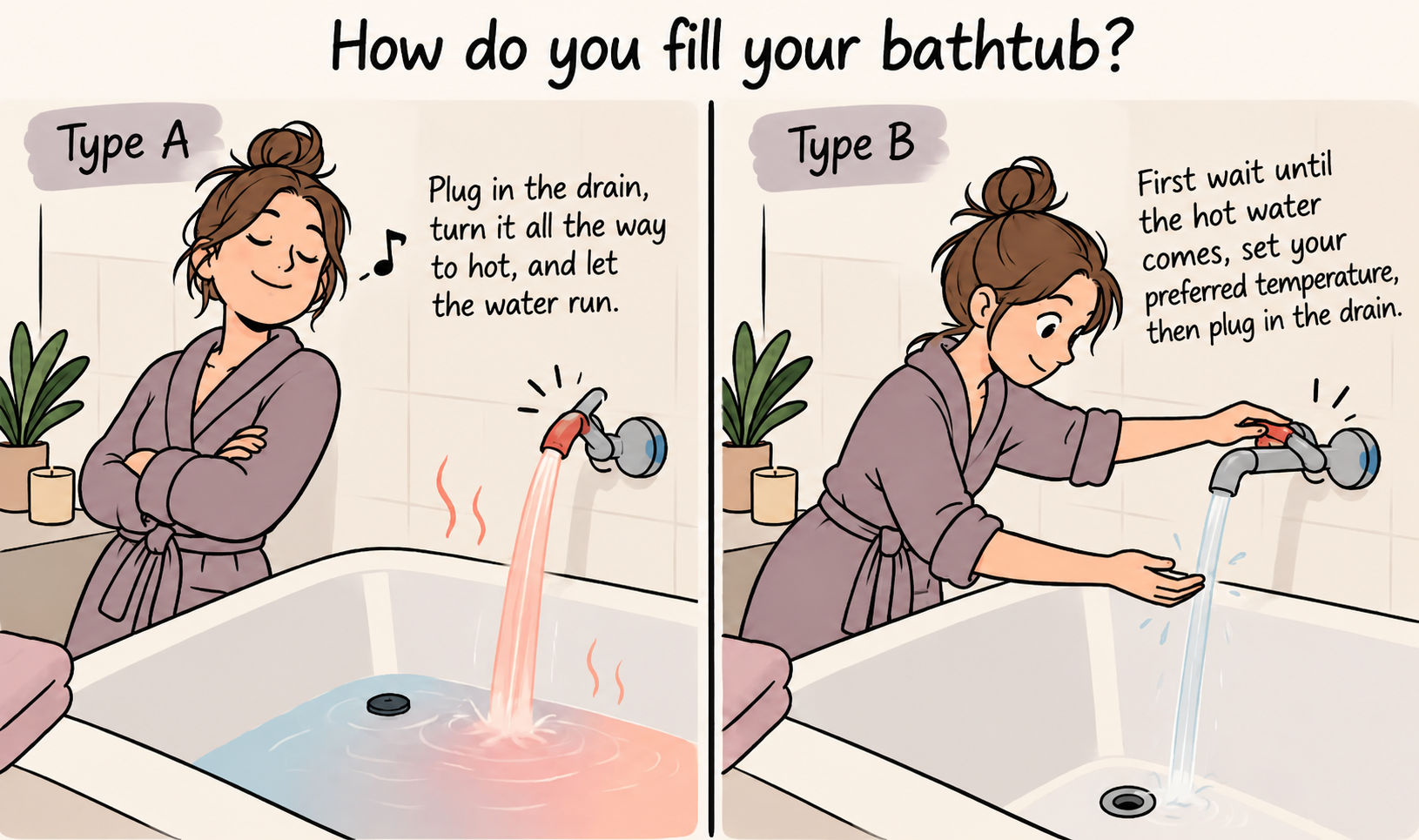
There are two types of people when it comes to filling a bathtub:
Some turn the tap all the way to hot and let the water run, knowing that the cold water at the beginning will eventually mix with the hot water, and the temperature will turn out more or less right.
Others wait until the hot water starts flowing, adjust it to their preferred temperature, and only then put the plug in.
What does that say about these people?
No idea, to be honest. 😉
I just noticed the other day that there are two different approaches, and I found the question intriguing. I also immediately wondered: “What would ChatGPT make of a question like this?”
Here’s what it came up with:
Type A: “Full heat, plug in, it’ll all balance out.”
This person tends to think in a more systemic and outcome-oriented way. They don’t need to control every moment of the process as long as they can roughly predict where it will end up. The initial cold water isn’t a mistake; it’s part of the equation. This could suggest a greater tolerance for temporarily suboptimal conditions, trust in past experience, and a certain willingness to improvise. Taken to the extreme: “I don’t need to optimize every single step as long as the overall result is right.”
Type B: “Get the temperature right first, then put the plug in.”
This person tends to be more process- and control-oriented. They want only the desired conditions to enter the system from the very beginning. The initial cold water is seen as an avoidable deviation. This could suggest a stronger need for predictability, precision, and immediate feedback. Taken to the extreme: “Why would I deliberately introduce a known error into the system and hope it corrects itself later?”
A controls the outcome. B controls the process.
Aha!
My own hypothesis is rather different: “Chances are, nobody has ever really given it much thought.”
We probably just adopt whichever method someone showed us at some point.
But when faced with a question like this, without any published research to draw on, conventional AI systems don’t seem to consider the variable “People simply don’t think about it.” Instead, they immediately start categorizing.
At least ChatGPT included the disclaimer that this is “not a psychologically validated personality test.”
Still, according to ChatGPT, plausible hypotheses can be drawn from it.